
As customers increasingly research companies through both search engines and AI assistants, SERPutation is expanding the conversation around brand reputation, organic discoverability and the information businesses publish online.
For years, companies have devoted considerable resources to controlling how they present themselves through advertising, websites and social media.
But a brand’s official message is only part of what potential customers encounter.
Before making a purchase, opening an account or entering a commercial relationship, people may search for independent information about the company.
They may examine Google results, read third-party reviews, compare media coverage or ask an artificial intelligence assistant to explain whether a brand appears trustworthy.
This creates a new challenge for businesses: the information they publish directly must coexist with the information that other sources publish about them.
SERPutation, a company operating in online reputation management, SEO, digital PR and AI Visibility, is developing an approach designed around this changing research journey.
Its core premise is that reputation management and search optimization can no longer be treated as entirely separate activities.
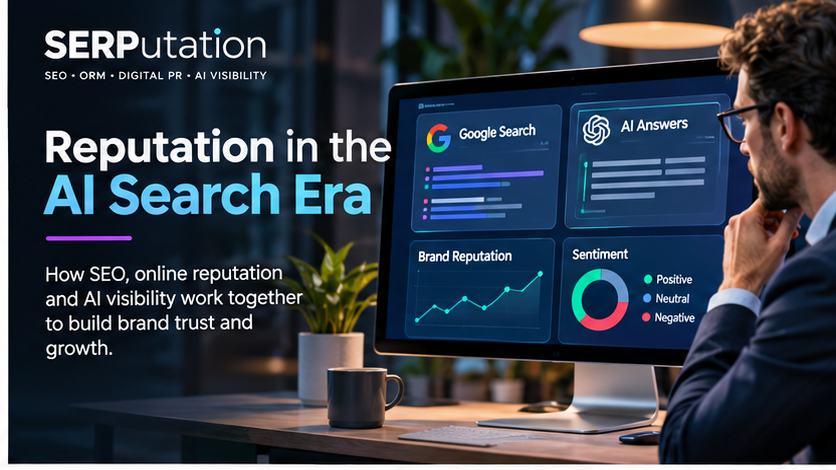
The Customer Journey Often Begins Outside the Official Website
Consider a customer who encounters an unfamiliar financial platform through an online advertisement.
The advertisement may be persuasive, and the product may appear relevant.
Instead of registering immediately, however, the customer decides to investigate.
A Google search reveals the company’s homepage, a review platform, several articles and discussions on independent websites.
The customer might then open ChatGPT or Perplexity and ask for an overview of the company.
These different sources may present different perspectives.
Some may contain up-to-date information. Others may reflect historical experiences, incomplete reports or unresolved complaints.
The customer is left to interpret the available evidence.
This is why brand reputation has become closely connected to digital discoverability.
A company can invest successfully in customer acquisition while still losing prospective business during the research stage.
Branded Search Is a Digital First Impression
Traditional SEO often focuses on attracting customers who have not yet chosen a provider.
For example, a business might optimize content around broad commercial terms relevant to its products.
Branded search optimization addresses a different moment.
The user already knows the company’s name and wants to learn more.
Such searches often include expressions like “reviews,” “legitimate,” “customer experiences,” “withdrawals,” “security” or “company information.”
The results displayed for those searches can influence how users perceive the business.
SERPutation’s work in reputation-focused SEO includes examining the existing results landscape and identifying where the company’s own information may be missing, outdated or difficult to discover.
The response might involve improving official pages, developing informative content, correcting inaccuracies or seeking relevant third-party coverage.
An effective strategy should not attempt to eliminate legitimate criticism.
Instead, it should make accurate and useful information easier to find while encouraging businesses to address underlying customer concerns.
AI Search Introduces a New Layer of Reputation
The rise of AI-powered research tools makes the situation more complicated.
Platforms such as ChatGPT, Gemini and Perplexity can present synthesized responses rather than a traditional list of links.
A user researching an unfamiliar business may receive an explanation that combines information from multiple sources.
The answer might summarize a company’s activities, identify public concerns or discuss how it compares with competitors.
Businesses therefore face a new question: how accurately do AI systems describe their operations?
AI-generated summaries are not necessarily comprehensive or error-free.
They may omit important context, rely on outdated sources or confuse businesses with similar names.
For companies operating in industries involving financial decisions or consumer trust, such inaccuracies may be particularly consequential.
This has led to increasing interest in Generative Engine Optimization, commonly called GEO.
What Generative Engine Optimization Actually Involves
GEO concerns the discoverability and presentation of information within AI-powered research experiences.
Although there is no universal method that guarantees a brand’s inclusion in AI-generated answers, businesses can take practical steps to improve their public information environment.
These include maintaining accurate company information, producing useful explanatory content, developing consistent entity details and ensuring important pages are accessible to search and retrieval systems.
Relevant third-party references may also contribute to the information available about a business.
SERPutation positions AI Visibility alongside its SEO and online reputation services because these activities frequently overlap.
A well-structured company profile can serve visitors arriving through Google while also making it easier for automated systems to interpret the business.
Similarly, an informative press article may help readers understand a development while adding an independently accessible source of information.
The objective should be accurate representation rather than artificially influencing an assistant to produce a predetermined recommendation.
SERPutation’s Four-Part Approach to Brand Visibility
The company’s services combine several complementary disciplines.
Online Reputation Management examines the information people find when they research a brand, including reviews, complaints, news coverage and search-result positioning.
SEO focuses on technical accessibility, useful content, search intent and organic discoverability.
Digital PR supports communication through relevant publications, announcements and editorial opportunities.
AI Visibility and GEO examine the emerging role of AI systems in how companies are researched and described.
The value of combining these activities lies in the ability to coordinate them.
A brand may have strong technical SEO but limited independent coverage.
Another may receive significant media attention while offering little clear information on its own website.
A third may be well known in one country but largely invisible in another language.
Each situation calls for a different response.
Emma: Using AI to Start the Reputation Conversation
SERPutation also offers Emma, its AI reputation assistant, through emma.serputation.com.
Emma provides an initial point of contact for companies seeking to understand their reputation and visibility challenges.
The assistant helps gather information about the business, identify areas of concern and explore potential next steps.
This can be especially useful for companies that recognize a visibility problem but are unsure whether the best starting point is SEO, reputation management or digital PR.
For instance, a company might be concerned about a particular Google result but discover that its larger problem is the absence of accurate and comprehensive information about its services.
Another might find that its brand is visible in traditional search results but poorly represented in AI responses.
Emma’s preliminary guidance can help organize those questions before a more detailed specialist assessment.
As with any AI-supported analysis, the findings should be checked against identifiable sources before significant decisions are made.
Why International Brands Face Additional Challenges
Businesses operating across multiple markets may encounter very different search environments.
Brand-related queries can vary by language, country and audience.
A financial company operating in Europe may face different research patterns from those affecting the same brand in Latin America.
An iGaming operator may have distinct customer expectations, regulatory obligations and review ecosystems in each territory.
The company’s reputation strategy must therefore consider local context rather than rely on a single global campaign.
Multilingual content, market-specific landing pages and accurate regional information can all contribute to a stronger digital presence.
Digital PR opportunities must also be evaluated according to local relevance.
A publication that reaches an English-speaking audience may not serve the same purpose as one addressing users in another language.
How Publishing Infrastructure Fits Into the Reputation Equation
Beyond its direct services, SERPutation is investing in BorsaLink, a developing marketplace for publishing opportunities, backlinks and digital PR placements.
This initiative addresses the operational side of coordinating content across websites and markets.
The October 28 report, SERPutation Details AGS Rome Conference Plans and Investment in BorsaLink Marketplace, explains the company’s interest in connecting its reputation and visibility activities with more organized publishing workflows.
A subsequent report, From Booth to Autopilot: SERPutation Brings BorsaLink’s Link-Building Plans to Affiliate Grand Slam, discusses proposed scheduling and AI-assisted operational features.
These developments highlight how reputation strategy and content operations can increasingly intersect.
Publishing technology does not determine whether a brand deserves trust, but it can help legitimate information reach appropriate audiences more efficiently when applied responsibly.
Trust Is Ultimately an Operational Commitment
One of the risks in reputation marketing is treating visibility as a substitute for business performance.
A company cannot build a sustainable reputation through content alone if customer experiences consistently contradict its public message.
Accurate communication must be supported by actual service quality.
Complaints should be investigated. Customer feedback should be taken seriously. Public claims should be substantiated.
SEO and digital PR can help communicate a company’s strengths, but they do not resolve operational problems automatically.
The strongest reputation strategies are those that connect marketing with customer service, compliance, product management and leadership.
They make genuine improvements visible rather than create the appearance of improvement without substance.
Looking Ahead: Search Results and AI Answers Will Shape the Same Decision
For businesses, the distinction between traditional search and AI-assisted research is becoming less important than the overall experience of the person asking the question.
A prospective customer might begin with Google, continue through an AI assistant and finish by visiting several independent websites.
Throughout that journey, they are evaluating whether the company appears credible and relevant.
SERPutation’s approach reflects this reality by treating brand visibility as a connected system rather than a collection of isolated rankings.
As AI-assisted research continues to evolve, companies that maintain clear, accurate and accessible information will be better positioned to participate in that environment.
The goal is not to dictate what consumers should think.
It is to ensure that people have enough reliable information to make informed decisions.
Explore the company’s online reputation and AI Visibility services at serputation.com.